










About Helping Your Boyfriend

A Spoiler-Light Reading of Care and Control

Helping Your Boyfriend is a horror romance visual novel by Zieelane and Mousefishdog. Its premise places you in a relationship with Adrian, a doctor, while a condition affecting your legs leaves your character unable to walk. You live together, wake during the night, and become involved in requests that make ordinary intimacy increasingly difficult to interpret. The useful question is not simply whether Adrian seems charming. It is what happens to your ability to understand, refuse, or question what someone asks you to do.

This page approaches the story through uncertainty rather than a perfect route checklist. It provides an embedded browser game, two optional videos, and original reading advice. The creator's advertised game includes four endings and five minigames, along with name, pronoun, and body-type customization. Those are descriptions of the official project, not a claim that every advertised feature has been verified in this hosted browser edition. The embedded build has not been playtested for this guide, and no choice sequence below is presented as an ending solution.

Expect violence, blood and gore, flashing imagery, sudden scares, and toxic relationship themes. The affectionate presentation does not turn these subjects into light romance. Review your own limits before starting, keep the volume comfortable, and stop if the material becomes unpleasant. Needing assistance is not the frightening idea here: this reading focuses on the possibility that information and dependence can be used to restrict another person's choices. That distinction matters when discussing a protagonist whose mobility is limited.

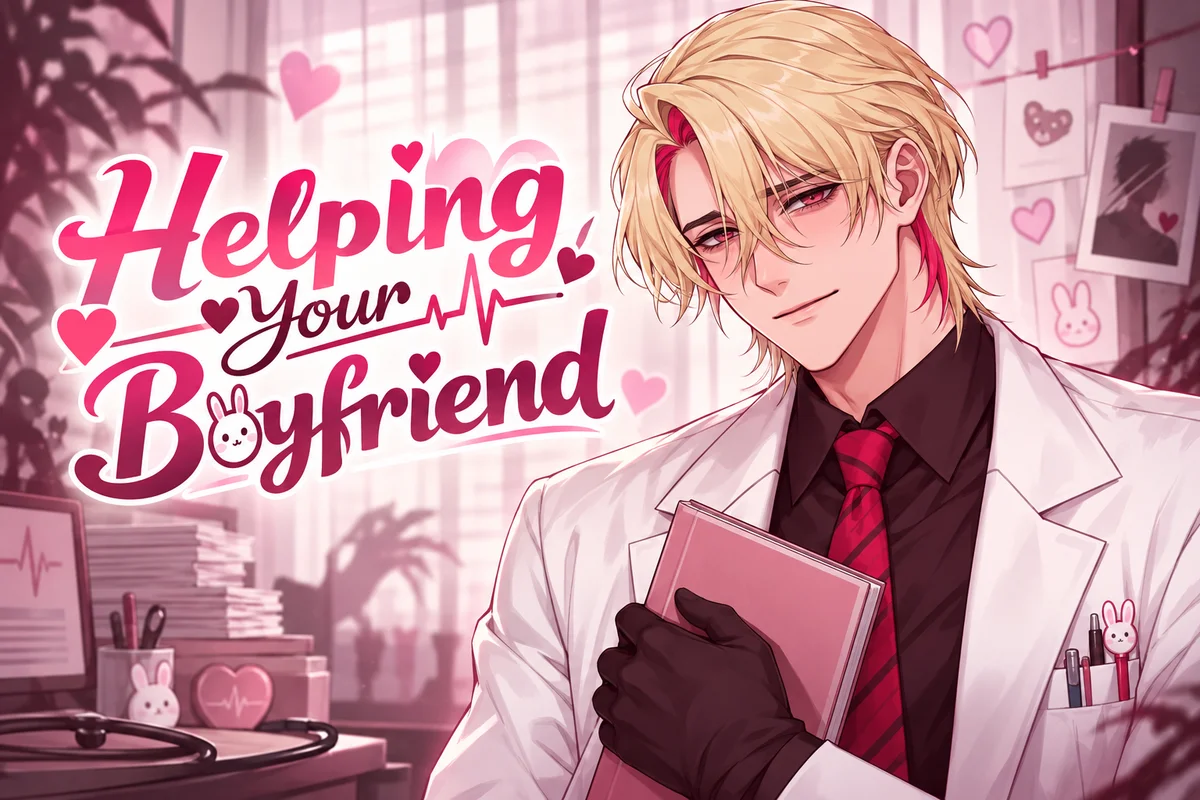
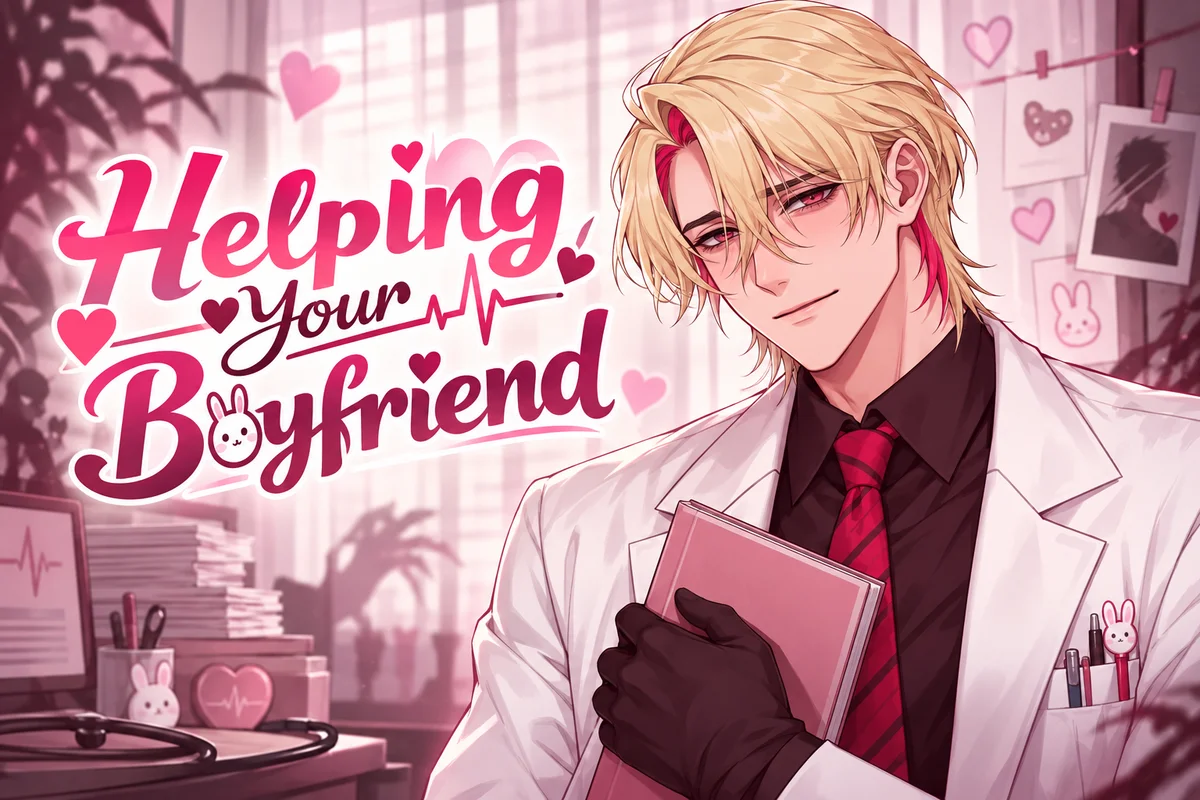
Illustrated Helping Your Boyfriend brand artwork with pink hearts and a blond doctor in a white coat

A Friendly Image Is Not the Same as Reliable Evidence

The supplied brand illustration places a white coat, a folder, heart shapes, and warm pink lettering in the same frame. It is presentation artwork, not proof of an event inside the game. That combination nevertheless offers a useful starting point for reading horror romance: familiar signs of competence and affection can invite trust before a character has done anything to deserve it. When you begin playing, separate what a scene actually shows from the impression its colors, pose, or vocabulary encourage you to form.

Adrian's role as a doctor makes that separation especially important. Medical expertise and a romantic relationship are different kinds of authority, and the story's premise places both close to the protagonist. Listen for the difference between an explanation and an instruction. An explanation gives the listener something they can evaluate; an instruction may only tell them what is expected. This is a literary way to examine the dialogue, not medical advice or a diagnosis of any fictional character. Let the text establish details before attaching a label to them.

Keep a small observation log if uncertainty is part of the appeal. Divide a note into what was said, what was visible, and what you inferred. For example, a reassuring sentence is evidence that reassurance was offered, not evidence that its claim was true. A suspicious expression is a reason to pay attention, not confirmation of a hidden motive. This simple habit keeps later revelations interesting because you can discover exactly which assumption changed, rather than remembering every earlier moment as obviously threatening.

Customization can help you establish the perspective you want to follow. The official project describes a selectable name, pronouns, and body type. Use the options available in the build to create a consistent character rather than treating personal details as a secret answer key. There is no verified basis here for claiming that a particular identity unlocks an ending. A useful first-run goal is much smaller: understand how your chosen protagonist responds to dependence, affection, and incomplete information over the course of an unfamiliar night.

Adrian smiling in a white coat with one black-gloved hand near his face against a pink background

Read the Request Before Trying to Please Adrian

One of the premise's unsettling tasks involves helping Adrian take apart old dolls. The wording makes it sound like a favor between partners, while the physical action asks the player to participate rather than merely listen. Before deciding what such a scene means, notice who proposes the task, how its purpose is explained, and how much room there seems to be for hesitation. These questions are more useful than assuming that every domestic activity conceals the same kind of threat. The story can complicate an apparently simple favor without requiring you to know its answer in advance.

Mouse dragging is part of the minigame control scheme. Treat each new task as its own interface: read the prompt, identify the object that can move, and try a measured drag rather than a rapid series of clicks. Where the game gives feedback, distinguish an input problem from a narrative consequence. An object that does not move might indicate that the pointer is outside the active area; it does not automatically mean your character has made a bad decision. This guide does not identify hidden timers, target locations, or success conditions that have not been verified.

The premise also includes a stranger who threatens the protagonist at night and pressures them to give medication. That pressure creates a second source of instructions. It is worth asking whether a demand becomes more credible simply because it challenges someone you already distrust. Threatening language can narrow attention until compliance feels like the only possible response. As a reader, you can pause and compare what each speaker knows, what they want you to believe, and what remains uncertain, even when the character is placed in a much more constrained situation.

Avoid treating this fictional medication scenario as a real-world procedure. Nothing on this page supplies dosing, administration, or treatment guidance. In the story, its value for discussion lies in responsibility and coercion: who is being asked to act, who carries the risk, and who withholds the explanation? Keep your notes centered on those relationships. If you later replay the scene, compare the exact language around the request instead of inventing a universal rule such as always obeying the stranger or always trusting the doctor.

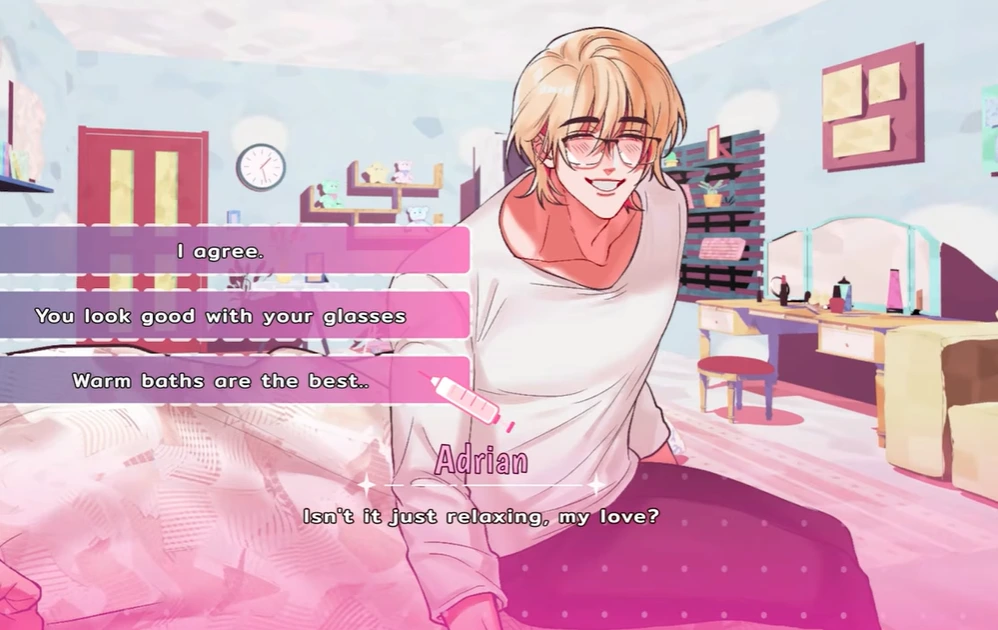
Adrian wearing glasses in a pastel bedroom while three pink dialogue choices appear on the left

Controls That Preserve Your Attention

Use a click or Enter to advance dialogue. Space hides the dialogue display, L opens the history, and A enables automatic advancement. Ctrl or Tab is used for skipping. These functions do different jobs: hiding text lets you inspect the image, history helps recover a line, automatic reading changes pacing, and skipping moves past material. On a first route, keep skipping off until you understand the interface. If dialogue seems absent, check whether it has been hidden before assuming the game has stopped rendering correctly.

For quick-time events, the supplied controls use direction keys together with Space. A key that hides dialogue in a reading scene may therefore perform an action when an event prompt is active. Follow the current prompt rather than repeating the last input that worked. Click inside the game frame first so keyboard focus belongs to the game, not the surrounding webpage. This is especially relevant if a direction key scrolls the website instead of responding to the event. Keyboard focus is a browser behavior, not evidence about a story branch.

The bell at the top provides access to saving, loading, and settings in the described interface. Inspect those options early, before an intense moment makes the menu harder to explore calmly. If save slots are available, keep an early reference save and a separate working save. Do not assume the game has saved automatically, that browser storage is permanent, or that progress will follow you to another device. A short note about the last completed scene can remain useful even if the save interface behaves differently in this hosted edition.

The screenshot beside this section shows a dialogue choice layout, not a recommended answer. Read all visible responses before clicking, and consider what each would communicate from your protagonist's perspective. A compliment, agreement, and change of subject may all sound pleasant while expressing different priorities. You do not need to calculate affection points that the game has not shown you. Following one understandable intention makes a first playthrough easier to reflect on than switching personalities whenever a new expression suggests an immediate reward.

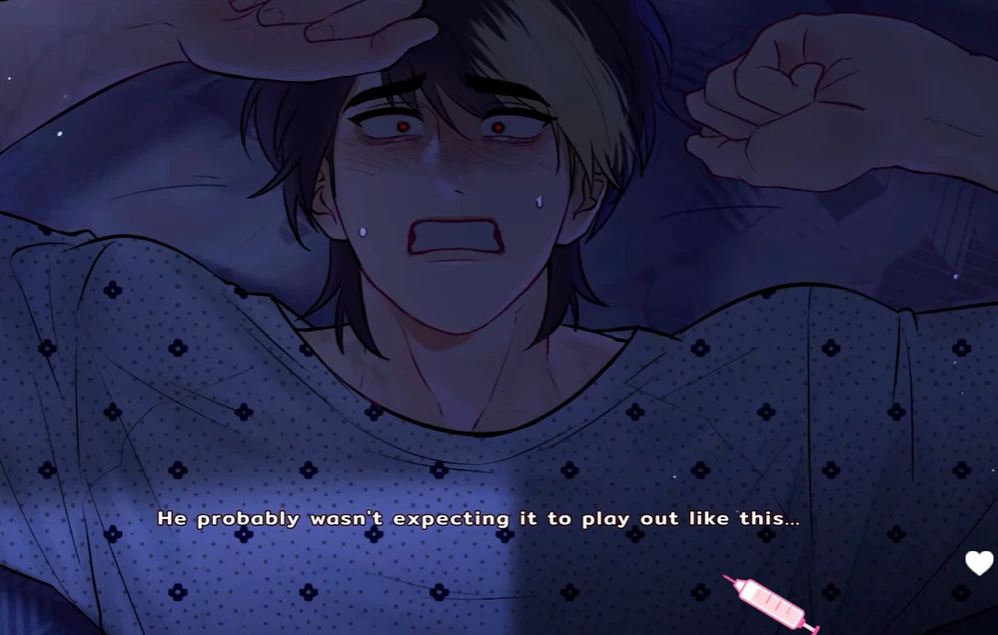
A frightened character lying on a pillow in a dark blue scene with raised hands and dialogue text

Replay Without Turning Uncertainty into a Fake Walkthrough

Four endings are advertised for the official game, but the number alone does not explain their requirements. Do not assume that there is a single final choice, a visible morality scale, or one ending assigned to each personality. After completing a route, write down its outcome in your own words and the decisions you actually remember. Keep observed events separate from guesses about how the game calculated them. This produces a useful record even if later runs reveal that your first explanation was incomplete.

For a second route, change one broad intention or return to one saved decision. You might read a request more skeptically, ask what information is missing, or pay closer attention to a character's reaction. These are interpretive approaches, not promised route triggers. Preserve the earlier save when possible, and compare the scene following a changed choice before skipping ahead. If nothing visibly changes, record that limited observation rather than announcing that the choice never matters. A consequence can be delayed, or the two runs may still share conditions you have not identified.

The five officially described minigames add another reason to keep outcome notes modest. A practical input challenge and a conversation choice are not necessarily evaluated in the same way. Without verified testing, it would be misleading to promise that failing a task opens a particular ending or that perfect execution guarantees safety. Record whether you completed the task and what followed. If you watch either embedded video, expect possible spoilers and use it to compare observable scenes, not as proof that its version and your browser build are identical.

If the player stays blank, allow remote assets time to load before refreshing once. A blocked external host, interrupted connection, or browser restriction can prevent an iframe from starting. Avoid clearing site data as the first troubleshooting step because it could remove progress. Mobile touch input may not reproduce mouse dragging or keyboard quick-time events, so mobile completion is not promised. This page's source integration does not establish compatibility, parent-domain permission, or every ending's availability in production. Those remain separate checks for a real play session, not claims made by this guide.

Watch Helping Your Boyfriend Videos

Helping Your Boyfriend Video 1

Optional video reference; footage may reveal story events or outcomes.

Helping Your Boyfriend Video 2

A second video reference. Save it for later if you prefer an unspoiled first route.

Helping Your Boyfriend FAQ

Who created Helping Your Boyfriend?

The creators are Zieelane and Mousefishdog. This page provides an independent guide and is not presented as an official developer website.

What kind of game is it?

It is a horror romance visual novel involving Adrian, a doctor boyfriend, a protagonist unable to walk because of a leg condition, and disturbing events in their shared home.

Are all four endings verified in this browser edition?

No. Four endings and five minigames are advertised for the official project. We have not playtested this hosted build or verified feature parity.

How do I advance and recover dialogue?

Click or press Enter to advance. L opens history, Space hides dialogue, and A enables automatic advancement. Ctrl or Tab skips; use skipping carefully on an unfamiliar route.

What inputs do minigames use?

The supplied controls include mouse dragging and direction keys with Space for quick-time events. Read the active prompt and click inside the frame before keyboard input.

Where are the save and settings controls?

Look for the bell at the top of the game interface. Check the available saving, loading, and settings options without assuming automatic or cross-device saves.

Can I customize the protagonist?

The official description includes name, pronoun, and body-type choices. Check which options are present in this browser build; no customization option is claimed here to guarantee an ending.

What content warnings should I read?

Expect violence, blood and gore, flashing imagery, jump scares, and toxic relationship themes. The romantic artwork does not mean the story is suitable for every player.

Does this guide contain exact ending instructions?

No. It offers spoiler-light reading and replay methods, not unverified choice sequences. The videos and screenshots can still reveal scenes, so view them according to your spoiler preference.